 | |||||||
| Home | Email Us | Find It | What's New | Back | Next | ||
| VIEWER MESSAGES | ||
|
| MISCELLANEOUS | ||||
|
||||
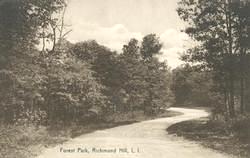 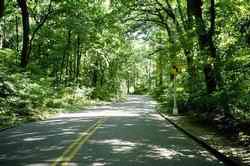 Pictures dated c. 1900 and 2001
Pictures did not appear in original article Click images to enlarge
Forest Park in today's Kew Gardens, NY. The monochrome picture was taken circa 1900.
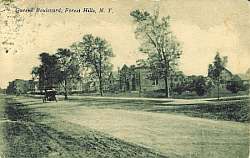 Picture dated c. 1920
Picture did not appear in original article Click images to enlarge
Hoffman Boulevard (today's Queens Boulevard) at the present day intersection of 71st and Continental Avenue in Forest Hills, NY sometime during the early Twentieth Century.
|
The Development of North Richmond Hill
An interview with Mr. Woodward, private secretary to President Peters of the Long Island Railroad is printed in the real estate section of this issue, in which he speaks of the Maple Grove cut-off. In this connection it may be well to recall the fact that the topographical maps already adopted provide for the construction of a parkway along the Union Turnpike 125 feet in width and for the construction of a similar parkway along the general line of the Hoffman Boulevard, but straightened and improved, of a width of 200 feet. This latter parkway will become the main thoroughfare of the island for all kinds of traffic other than that handed by the railroad, and the Union Turnpike parkway will connect this great thoroughfare with the Forest Park region, providing, in connection with the drives through Forest Park and Cypress Hills Cemetery, a magnificent connection with the parkways of the city of Brooklyn. The northern part of Richmond Hill will therefore be intersected and improved by these two great parkways, and will be at the centre of carriage and automobile traffic.
Forest Park, of course, which bounds the northern part of Richmond Hill on the west for a distance of a mile, the boundary line running from Myrtle avenue to Union Turnpike, will be a great element in the development of this property, and will greatly add to its desirability and value. Simultaneously and while these great improvements are being made, the entire Man tract will be developed on plans dictated by the judgment of the best landscape architects, and the beautiful hills, standing as they do upon the boundaries of a great park, abutting upon parkways and commanding views of the sea on the south, the Sound on the north, the park on the west , will be brought directly into the market. All of this tract will be restricted for the highest class of private residences, and will be adequately served by the railroad station referred to in Mr. Woodward's interview.
As the regular express trains now run from Maple Grove to Long Island City in twelve minutes, of which rather more than half is consumed in passing through the long and complicated yards at Long Island City, it is fair to believe - and the railroad people give their assurance that it is true - that after the heavy grade and the present crooked line have been eliminated as proposed, a passenger may take an electric train from the junction of Lefferts avenue with the railroad and be landed in the centre of the island of Manhattan in fifteen minutes. This means that the section referred to will be nearer to the centre of activities in New York in point of time than the property on Fifth and Eighth Avenues which fronts upon Central Park.