| Next
Back Home Email Me About Me Read Guestbook Guestbook Archives Sign Guestbook Where Are They? What's New Find It Need It Links Books Your Old Photos 1920's Map Current Map |
Home | Next | ||
Article No. 1 | Article No. 2
[Reprinted with permission from the March 27, 1964 New York Times. Copyright © 1964 by the New York Times Co.] The first paragraph of this article contains 6 errors. As will be explained below:
[The Times article continues:] Kitty might not have been saved in any case. I'll explain why at the end of this article. [The Times article continues:] The fact that the neighborhood was "shrouded" in "slumbering darkness" is something to keep in mind in evaluating what the witnesses were able to see. [The Times article continues:] Kitty was probably not headed for the police call box. More likely she was trying to reach a neighborhood bar called Old Bailey just a few doors up Austin Street. Click here for diagram. [Bracketed text is mine.] [Footnote 1] [The Times article continues:] Much has been made of the fact that the first attack occurred near a street light. In its 1999 program on the case, the History Channel showed a picture of the street light as it appeared in 1999 and said it created a "stage-like scene" for the attack. [Footnote 2.] However, the street light there today (and in 1999) is not the one that was there the night Kitty was attacked. The new one is brighter and covers a wider zone. [Footnote 3.] Surviving witness and retired New York City police officer, Michael Hoffman, says in an affidavit that the old street light was not very bright. [Footnote 4.] Hoffman's recollection is corrborated by the testimony of the killer, Winston Moseley. At one point during his murder trial, Moseley testified that he did not worry about being identified when he returned to continue his attack on Kitty because: "... it was late at night and I was pretty sure that nobody could see that well out of the window."
[Footnote 5] So, while the old street light did make things easier to see, it was not as much help as is now supposed. Moreover, in 1964 unlike today, the adjacent Long Island Rail Road parking lot was not lit. So, on the night Kitty was attacked, the absence of that ambient light added to what the Times described above as the "darkness" that "shrouded" the neighborhood.
[The Times article continues:] The 10 story building was the Mowbray Apartment House which occupies the length of the block. (I estimate the Austin Street side of the building to be about 150 feet long.) The Mowbray is almost flush with the sidewalk and trees line the block just as they did then. The only illumination was from the street light. Click here to view a 2003 photograph of the scene. Given the building's size and the presence of trees along the street, residents on the upper floors, in the courtyard, and further down the block would not have had the same close and unobstructed view as those on the first few floors directly across the street, nor would they have been able to hear anything as well. [To see a copyrighted 1964 photograph (on another website) of the street - lined with trees - as seen from the top floor of the Mowbray, click on the following link and scroll down to page 21. Close out the window to return here. Click Here.] The Times mentions just above that "Lights went on in the ten-story apartment house" after Kitty's outcry. Witnesses who had to turn on the bedroom lights to get to their windows were probably seniors - a conclusion corroborated by one newspaper at the time which reported, "Many of the people who live in the buildings near Kitty Genovese's apartment are elderly". [Footnote 6.] If so, then their age is another factor to consider in evaluating what the witnesses were able to see and hear and how they reacted. [The Times article continues:]
When did the witnesses get to their windows? "[Kitty] got as far as a street light in front of a bookstore before the man grabbed her. She screamed. Lights went on in the ten-story apartment house at 82-67 Austin Street, which faces the bookstore. Windows slid open and voices punctured the early-morning stillness. Miss Genovese screamed: "Oh, my God, he stabbed me! Please help me! Please help me!" [Bracketed text is mine.] Notice the Times does not say whether Kitty was stabbed for the first time before or after the witnesses got to their windows. The way these sentences are worded (saying Moseley "grabbed" Kitty instead of saying he "stabbed" her), it leads the casual reader to believe that the witnesses got to their windows before Kitty was stabbed - which is something the Times has not actually said. Since the Times set out to show that the witnesses saw all 3 stabbings, this seems a crucial point to fudge. Now, compare that to another account of the first attack written five weeks later by Times Metropolitan Editor, A. M. Rosenthal, the man responsible for this 1964 Times article. "Lurking near the parking lot was a man. Miss Genovese saw him in the shadows, turned and walked toward a police box. The man pursued her, stabbed her. She screamed, "Oh my God, he stabbed me! Please help me! Please help me! [Footnote 7.] This same account can be found in Rosenthal's book about the case, Thirty-eight Witnesses. [Footnote 7.1.] Freed of the fudge factor, this later New York Times story says that the witnesses were awakened and got to their windows after the first attack. Except for two witnesses named Joseph Fink and Andree Picq [see below], no one is known to have seen that first attack. Rosenthal's version of the initial attack squares with that of the Queens County District Attorney who also said that the witnesses got to their windows after the first attack. This is an excerpt from the D.A.'s appellate court brief: "After she parked her car, Katherine Genovese became frightened and ran when she saw Moseley. He ran after her for about twenty feet and stabbed her twice in the back, on the street. Her screams awakened several of her neighbors ... ."
[Footnote 8.] The sequence of events described by Rosenthal and the District Attorney also sounds more believable. Once he caught up with her, I think Moseley would have stabbed Kitty immediately rather than waited for an audience to assemble. [Footnote 8.1.]
Q. You said you went up to her or towards her while she was still in the parking lot? [Footnote 9.] Here is how Moseley described the first attack during his police interrogation, indicating that the chase up Austin Street was a very brief one: "... 'She started to run up the street. She ran fast, but I can run much faster. I caught up with her in front of one of the stores. The knife was in my hand now. I jumped on her back and stabbed her a few times.'" [Footnote 9.1.] Moseley's account of the details of Kitty's murder were considered very credible. According to a 1964 issue of Life Magazine: "Moseley has developed a reputation for truthfulness in such matters. No one has had occasion to doubt one word of his detailed confession about killing Kitty Genovese."
[Footnote 9.2.]
None of these witnesses testified to seeing Kitty stabbed, and none of them said they saw the knife or any blood. Only two witnesses are known to have seen the first stabbings.
"He was seated in a sofa chair facing a very large bay window, and he actually saw the first attack take place, he knew exactly what was happening. He saw the knife, the shining blade of the knife as it struck Kitty in the back four times."
[Footnote 15.1.] If there were any other eye witnesses to the first stabbings, they have never been identified. Since Charles Skoller interviewed 20 to 25 of the witnesses in preparation for the trial of Kitty's killer, [Footnote 15.2.], I assume he would have said if there were any other eye witnesses. He does not. What he did tell The New York Times is that he does not believe there were 38 eye witnesses. He found only about half a dozen people who saw anything that could be used at trial. [Footnote 15.3.]. We have already mentioned 5 of them. "The man pursued her, stabbed her. She screamed, "Oh my God, he stabbed me! Please help me! Please help me!
[See, Footnotes 7 and 7.1 above.] Once again, Rosenthal's sequence of events seems the more likely one.
Even if we accept (as I do), that Kitty did cry out that she had been stabbed, that does not necessarily mean that other witnesses heard her say it. The Times does not say how many did. Once again, we are simply led to assume that everyone did. Whether a given witness heard it or not would have depended on the interplay of a number of factors that the Times does not consider, e.g.:
In my experience, it can be difficult to make out the words of people speaking or shouting outside on a city street through closed windows, even though their voices might be clearly audible. Furthermore, since Kitty's outcry was what awakened them, it would have been very easy for witnesses (especially elderly witnesses) to miss parts of what she was saying. [Footnote 22.1.] All a witness had to do was miss that one crucial word "stabbed", and the meaning of Kitty's outcry changes. "Help me, I've been stabbed!" is a much more urgent plea than just, "Help me, I've been ___!" As the New York Daily News crime reporter, John Melia, observed in a 1984 article: "In reconstructing the crime, you have to remember that it was 3:30 on a winter morning, a time when most people are in bed asleep and windows are closed, a time when people are not easily roused."
[Footnote 23.]
"[W]e must distinguish between the facts of the murder as finally known and reported in the press, and the events of the evening as they were experienced by the Kew Gardens residents. ... What [the residents] had, instead, were fragments of an ambiguous, confusing and doubtless frightening episode ... ." [Bracketed text is mine.] [Footnote 25.] [The Times article continues:]
Were there 38 eye witnesses?
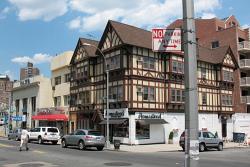
"Of the thirty-eight [witnesses], about eighteen had witnessed or heard each of the attacks; the other twenty had heard or seen one - enough to make them witnesses in court." [Bracketed text is mine.] [Footnote 27.] Rosenthal gives no breakdown of the number of eye witnesses versus the number of ear witnesses. Notice how his statement is so vaguely worded that it would be true even if there had been only 2 eye witnesses. At a Kitty Genovese Forum held on March 9, 2004 at Fordham University, A.M. Rosenthal denied that he or any other reporter at his paper had ever said there were 38 eye witnesses. Click here to hear a WMA file [11KB] of Rosenthal's statement. One of the prosecutors at Moseley's trial is former Queens County Assistant District Attorney, Charles Skoller. In an interview with The New York Times, Skoller said: "I don't think 38 people witnessed it. I don't know where that came from, the 38. I didn't count 38. We only found half a dozen that saw what was going on, that we could use." [Bracketed text is mine.] [Footnote 27.1.] In a brief submitted to the New York State Court of Appeals, Queens District Attorney Thomas Mackel mentioned only 3 eye witnesses: "Five occupants of apartments in the vicinity where the deceased was found . . . were awakened on March 13 by screams in the early morning ... . Three of these upon going to their windows actually observed a man brutally attacking a girl in front of a book store." [Footnote 28.] The D.A.'s reference to 3 people seeing a brutal attack was a bit of hyperbole. The brief goes on to explain that only one of those 3 witnesses (Andree Picq) said she saw Moseley beating Kitty. Robert Mozer only saw Moseley kneeling or bending over Kitty before he ran away. Irene Frost just saw Moseley running away. [Footnote 29.] In an article written in 1984, New York Daily News crime reporter, John Melia, expressed doubt that there was anything close to 38 eye witnesses. [The Times article continues:] Every trial witness who saw him testified that Moseley ran back to his car, he did not walk. [Footnote 30.] As Moseley later explained, he suddenly realized that his car was parked nearby, where it might easily be seen by witnesses. [Footnote 31.] And, as you will read below, he came to that realization too late. [The Times article continues:] None of the testimony at Moseley's trial suggests that Kitty had to struggle to get up. Both trial witness, Andree Picq, and surviving witness, Michael Hoffman, say only that she got up "slowly". [Footnote 32.] Trial witness, Robert Mozer testified that: "She got up, stood up, and kind of looked around like that ... ." [Footnote 33.] Trial witness, Irene Frost testified that: "[Kitty] got up. Then it looked like she was reaching for her purse. She bent down again and picked something up. I don't know what it was ... ." [Bracketed text is mine.] [Footnote 34.] So far, there was nothing in Kitty's body language to tell an unknowing onlooker that she was gravely wounded. Everyone agrees that Kitty then walked away, but there is disagreement as to the steadiness of her gait. Witness, Andree Picq said that Kitty walked away "slowly". [Footnote 35.] According to former New York City Chief of Detectives, Albert A. Seedman: "[Kitty] was not staggering. If anything, her step was almost dreamlike." [Bracketed text is mine.] [Footnote 36.] The History Channel described her walk the same way. [Footnote 37.]. If these accounts are correct, then there was still nothing about her body language that would put eye witnesses on notice that Kitty was badly wounded. However, surviving witness, Michael Hoffman, and his father had perhaps the closest view of all. Hoffman describes her walk as more labored. "The way she walked made us think she was either drunk, or had been beaten up. She walked slowly, holding on to the building wall for support as she did. She staggered." [Footnote 38.] Ordinarily, that kind of unsteady gait would be a sure sign to an onlooker that something was wrong even if it does not necessarily suggest the possibility of fatal wounds. However, there was another factor that shaped the perceptions of witnesses who did not have Hoffman's view. The Times does not mention it, but the first attack occurred only a few feet from a bar called Old Bailey. Loud early morning behavior outside of any bar is not unusual, and as mentioned above, Old Bailey was no exception. [Click here.] Not having seen the first stabbing, many witnesses probably attributed the incident to alcohol. So, the fact that Kitty got up and walked away at all - whether staggering or not - must have been falsely reassuring to a lot of onlookers who would have thought that everything was really all right, her initial screams notwithstanding. According to Harvard University Professors Stanley Milgram and Paul Hollander: "The incongruity, the sheer improbability of the event predisposed many to reject the most extreme interpretation: that a young woman was in fact being murdered outside the window. How much more probable, not to say more consoling, was the interpretation that a drunken party was sounding off, that two lovers were quarreling or that youths were playing a nasty prank." [The Times article continues:] If lights went out, then it looks as if witnesses went back to bed. That fact has to mean they did not understand what was happening. Life Magazine suggested much the same thing in an article written shortly after the murder. "Not all of these people, it must be said, understood they were watching a murder. Some thought they were looking at a lovers' quarrel. Others saw or heard so very little that they could not have reached any conclusion about the disturbance." [Footnote 40.] I do not believe any of the witnesses realized at this point that they were watching a murder in progress. [The Times article continues:] There was a drugstore located at the corner of the 2 story Tudor building right next to the parking lot. Click here for diagram. The Times says that Moseley returned just as Kitty was rounding that corner. However, this part of the Times story is clearly wrong. Although Moseley was to return, he would not do so for another 10 minutes or so. [Footnote 41.] By the time he did, Kitty had made her way to the rear of the 2 story Tudor Building and collapsed in a small hallway inside. Click here for diagram.
There was no evidence at trial that Moseley returned before then or that he intercepted Kitty near the drugstore or on the parking lot side of the 2 story Tudor Building. In fact, while Kitty was walking to the back of the 2 story Tudor Building, Moseley was off moving his car to a parking space on another street. [Footnote 42.]
Click here for diagram. So, even if they had not gone back to bed, the other Mowbray witnesses could not have seen Kitty for more than the few moments it would have taken her to walk the forty or so feet to that corner - a period of time far shorter than the 30 minutes reported by the Times in the story's lead paragraph. [Footnote 43.] [The Times article continues:] The Times has just described an attack that, according to every other source I've checked, never occurred:
I can find only one piece of contrary evidence. One year after the murder, the wife of trial witness, Samuel Koshkin, recalled seeing Moseley return three times to attack Kitty. [Footnote 54.] All things considered, I have to believe that 12 months after the fact, Mrs. Koshkin was mistaken in what she remembered. For one thing, if Moseley "returned" three times, that would amount to four attacks - one more than even the Times or any other media outlet ever reported. Furthermore, Mrs. Koshkin's recollection is uncorroborated by the Queens District Attorney, the former Chief of Detectives, Albert A. Seedman, and all the trial testimony including that of her husband. [Footnote 55.] [The Times article continues:] 3:35 A.M. is about 15 minutes after the first attack, which the Times reports began at 3:20 A.M. All of the sources I've checked, including this Times article, seem to say that Kitty had made it around to the back of her building well before 3:35 A.M. So, contrary to the lead paragraph of this story, the witnesses could not have watched her for "more than half an hour" because within a minute or so after they first got to their windows, she was no longer in their line of sight. Click here for diagram.
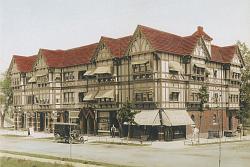
[The Times article continues:] The one trial witness who was watching Kitty at this time testified that she walked to the back of the building. There is no suggestion that she crawled although as she made her way along the parking lot side of the 2 story Tudor Building, she began to stagger. [Footnote 56.] [The Times article continues:] The final act in this tragedy took place inside a hallway in the rear of the 2 story Tudor building - the side that that faced away from The Mowbray. Click here for picture.
That means none of the Mowbray witnesses could possibly have seen this stabbing, and the Times' 4 column headline and lead paragraph is clearly wrong in saying they did. (This second attack was by far the longer of the two and involved an attempted r*pe. I am omitting the details of the second attack since they have no bearing on the points I am trying to make.)
Kitty's failure to make any further outcries as she made her way from Austin Street to the rear hallway is not surprising. She was badly wounded by the initial stabbings and probably in shock. Although the Times says she screamed during an attack by the drugstore or parking lot side of the 2 story Tudor Building, we now know that no such attack took place and no such screams were testified to at trial. [The Times article continues:] The neighbor was 31 year old Karl Ross, a poodle trimmer who had once sold Kitty a dog. Ross did not live in the Mowbray. He lived in the 2 story Tudor Building. [Footnote 57.] Click here for diagram. The door to his apartment was one flight up from the small hallway in which Kitty was attacked for the second time. [Footnote 58.] In an earlier version of this web page, I made the argument that Ross may not have been sure about what was happening at the foot of the stairs below his apartment door. I now believe that he did know what was going on. In 1984, The New York Times reported that: "One who [remembered the night Kitty was killed] is an 83 year old woman, who lived next door to Miss Genovese. She was awakened at 3:30 A.M. that night when a friend called to say he had seen the attack but was intoxicated and did not want to deal with the police." [Bracketed text is mine.] [Footnote 59.] I believe, for the following reasons, that the intoxicated witness referred to in the 1984 Times story was Karl Ross.
[The Times article continues:] |